How it works
How the helper hands skills to each CLI, what keeps a long sprint going past a full context window, the constraints every sprint holds to, and which providers see your code. The design document has the full design: phases, coordination modes, the shared ops/ files and the security model.
Portable skill injection
Skills are model-agnostic markdown files that any agent can consume, so the methodology an agent follows is decoupled from the model that executes it:
# All external-agent invocations go through the unified helper
source ${CLAUDE_PLUGIN_ROOT}/scripts/invoke-external.sh

# Antigravity via native agent definition (skill embedded in the agent body)
invoke_antigravity "codebase-analyst" \
  "Analyze the full codebase. Write findings to ops/ARCHITECTURE.md." \
  "$AGY_OUT" 600

# Codex via native agent definition (skill embedded in the agent body)
invoke_codex "test_writer" \
  "Write tests for changed files." \
  "$CODEX_OUT" 900
TRIFORGE_AGY_MODE (injection | native | auto; default auto since 4.0) governs how the helper routes Antigravity. The agent pack (antigravity-agents/) ships in agy's Markdown-agent format (mainAgent/subagent/commandExecutionPolicy, agy tool names), and session start reinstalls it whenever the plugin version changes. native passes --agent <name> when agy agents lists it, auto goes native only when it is listed, and injection prepends the agent body (with its embedded skill) to the prompt. The default became auto after the native round-trip (AGY-12) and the native-mode negative (AGY-16) passed in two consecutive probe records (D-042); a regression in either row reverts it. Codex definitions deploy as .codex/triforge-agents.toml, never under .codex/agents/, which Codex ≥ 0.147 sweeps as standalone role files.
Context Recovery
Seven safeguards keep long sprints from dying to context limits:
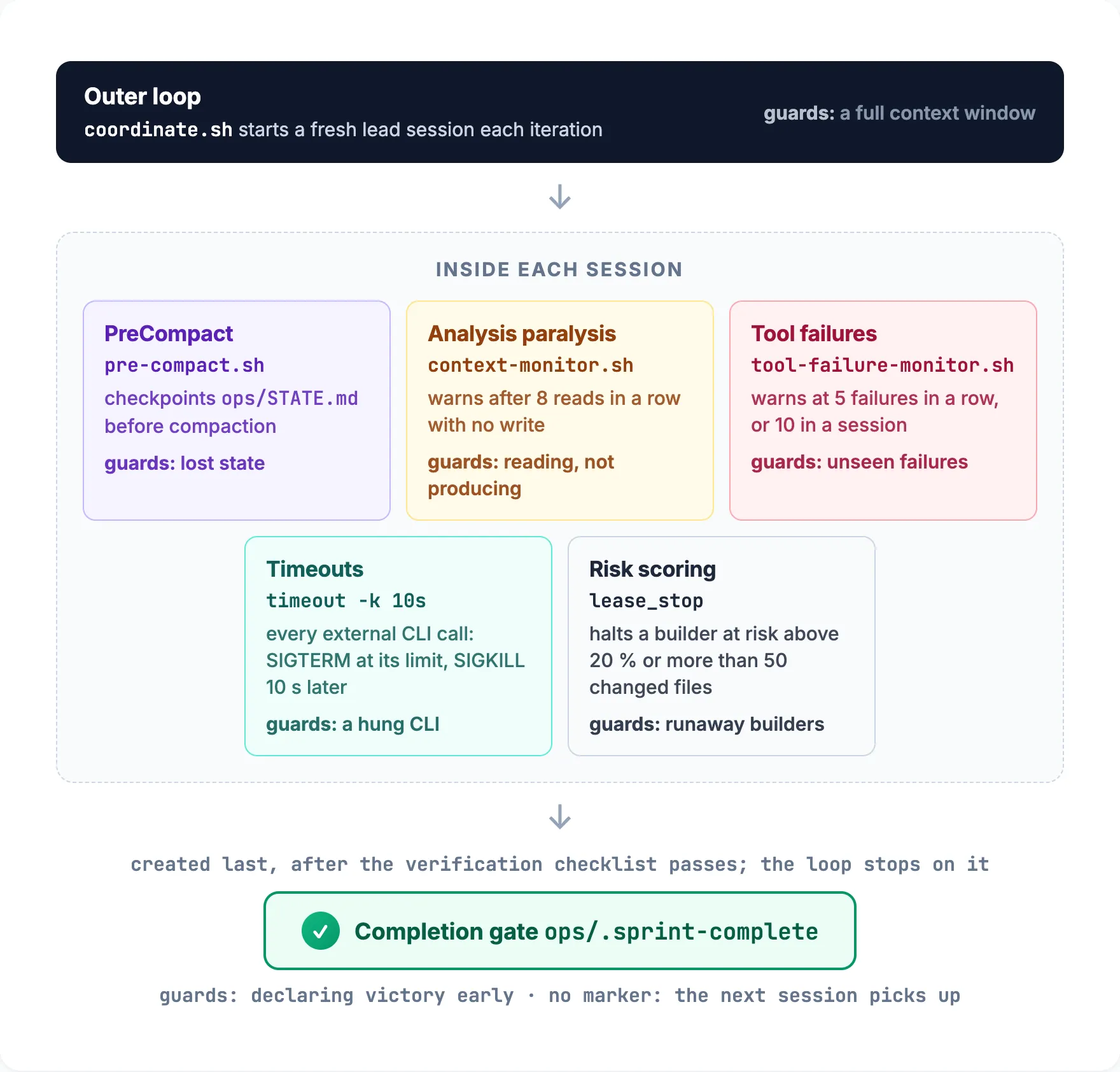
| Layer | Mechanism | Guards against |
|---|---|---|
| Completion gating | The ops/.sprint-complete sentinel, created only after verification passes, is the authoritative signal. Under a Claude Code lead coordinate.sh leads every session prompt with the native /goal checklist and at-ship / at-coordinate print a copyable /goal line, but /goal is an assist (CC-03 went 0 of 3 on 2.1.318) and ops/.sprint-complete plus coordinate.sh decide completion. A Codex lead has no /goal, so its sessions complete on the sentinel alone |
The lead declaring victory early |
| Outer loop | scripts/coordinate.sh starts a fresh lead session per iteration with the lead's registry launch line and the [lead] model and effort, runs the git integrity check before each session, stops after one session on a login or quota failure, detects completion through the sentinel, and notifies you. A Codex lead's launch line needs --allow-full-access (otherwise it prints the line and exits 77), and under nohup, cron or CI the script exits 45. Unattended runs walks through it |
Context window filling up |
| PreCompact | pre-compact.sh checkpoints STATE.md before context compaction |
State loss during mid-sprint compaction |
| Analysis paralysis | context-monitor.sh warns at 8+ consecutive reads without writes. The lead's tool vocabulary in the registry decides what counts as a read; under a Codex lead, a shell command that only reads (cat, sed -n, git log) counts |
Reading without producing |
| Tool failure monitor | tool-failure-monitor.sh warns at 5 consecutive or 10 total tool failures in a session |
Silent failure accumulation |
| Subprocess timeouts | Every Antigravity and Codex call runs under timeout -k 10s: SIGTERM at its limit, SIGKILL 10 s later |
Hung external agents blocking the pipeline |
| Risk scoring | Per-builder risk accumulation; a builder is halted at risk above 20 % or more than 50 changed files | Runaway builders |
Key constraints
CONTRACTS.mdis never modified directly during review; changes are proposed inMEMORY.mdfirst.- Any roster member is an eligible builder, and the single-writer rule is retired. Safety comes from per-task leases, worktree isolation and mandatory cross-review by a pinned non-author reviewer. No agent self-merges, and the lead promotes to the main branch only after the wave's integration check.
- Parallel reviews are safe because reviewers write to separate
ops/REVIEW_*.mdfiles. - Every review lane ends with a Coverage line, and a lane that reports less than
Coverage: complete, or omits the line, is a gap the cycle cannot converge on. The line is self-reported: nothing yet binds it to the reviewed snapshot. - A task gets at most 3 review cycles before it escalates to you.
- Phase 0 can be skipped for small bug fixes, same-session continuations, or unchanged codebases (use
at-quick). - Completion requires creating the
ops/.sprint-completeruntime marker only after the verification checklist passes.
Data egress and credentials
See Data egress.