Workflows
Every goal goes through the same phases, and each phase has a lead workflow.
Sprint Pipeline (at-ship)
Run at-ship (/at-ship <goal> under a Claude Code lead, $agent-triforge:at-ship <goal> in a Codex prompt) to run every phase autonomously, or run each phase's lead workflow yourself. at-build promotes the integration branch once, after its last wave, and writes the commit it started from as a Build base: line in ops/TASKS.md; at-review reviews from that commit, so a review run on its own after a build still covers the whole build.
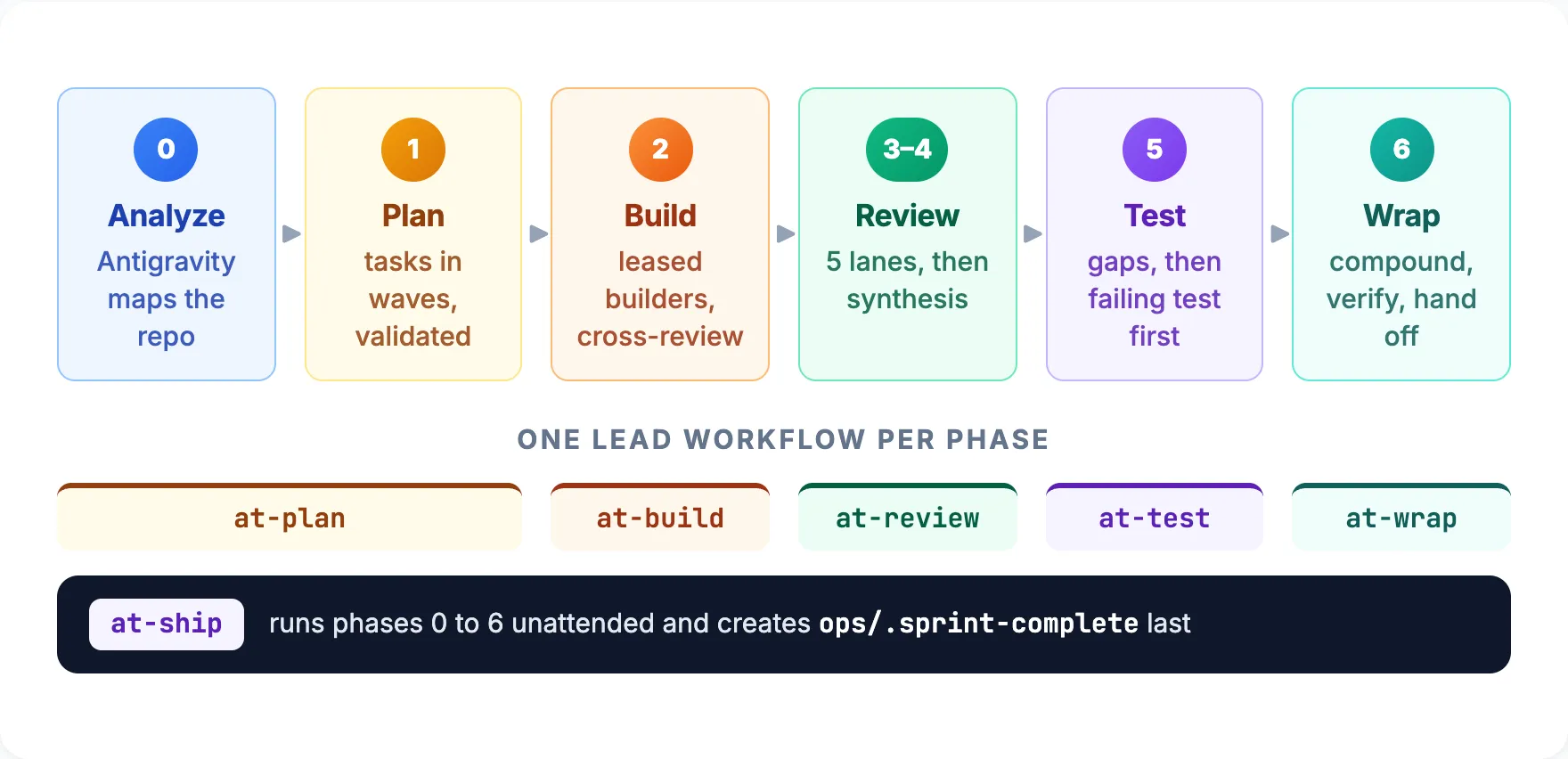
| Phase | What happens | Agents | Lead workflow |
|---|---|---|---|
| 0, Analyze | Full-repo scan: architecture, patterns, contracts, debt | Antigravity CLI + codebase-mapping |
at-plan |
| Pre-plan | Search institutional knowledge for relevant past solutions, skipped while the store holds only the skeleton | learnings-researcher |
at-plan |
| 1, Plan | Decompose the goal into tasks with shadow paths and error maps, grouped into waves | Lead + writing-plans |
at-plan |
| 1.1, Ambiguity | Surface the 3 most critical unverified assumptions and ask you to confirm or correct them | Lead | at-plan, at-ship |
| 1.5, Validate | Validate assignments, dependencies, scope and shadow paths, up to 3 rounds | plan-checker |
at-plan |
| 2, Build | Wave orchestration over leased builders, with integration verification between waves | Leased builders, or the team-lead persona |
at-build |
| 3 and 4, Review | Five lanes at once (Antigravity, Codex, security-sentinel, performance-oracle, code-simplicity-reviewer), then synthesis with confidence tiers; up to 3 cycles |
Antigravity + Codex + three review personas | at-review |
| 5, Test | Gap analysis, tests written failing first, up to 3 fix cycles, then escalation to you | Codex CLI (test_writer) |
at-test |
| 6, Wrap | Document solutions, archive reviews, verify, write STATE.md, create ops/.sprint-complete last |
Lead + knowledge-compounding |
at-wrap |
Planning Pipeline (at-plan)
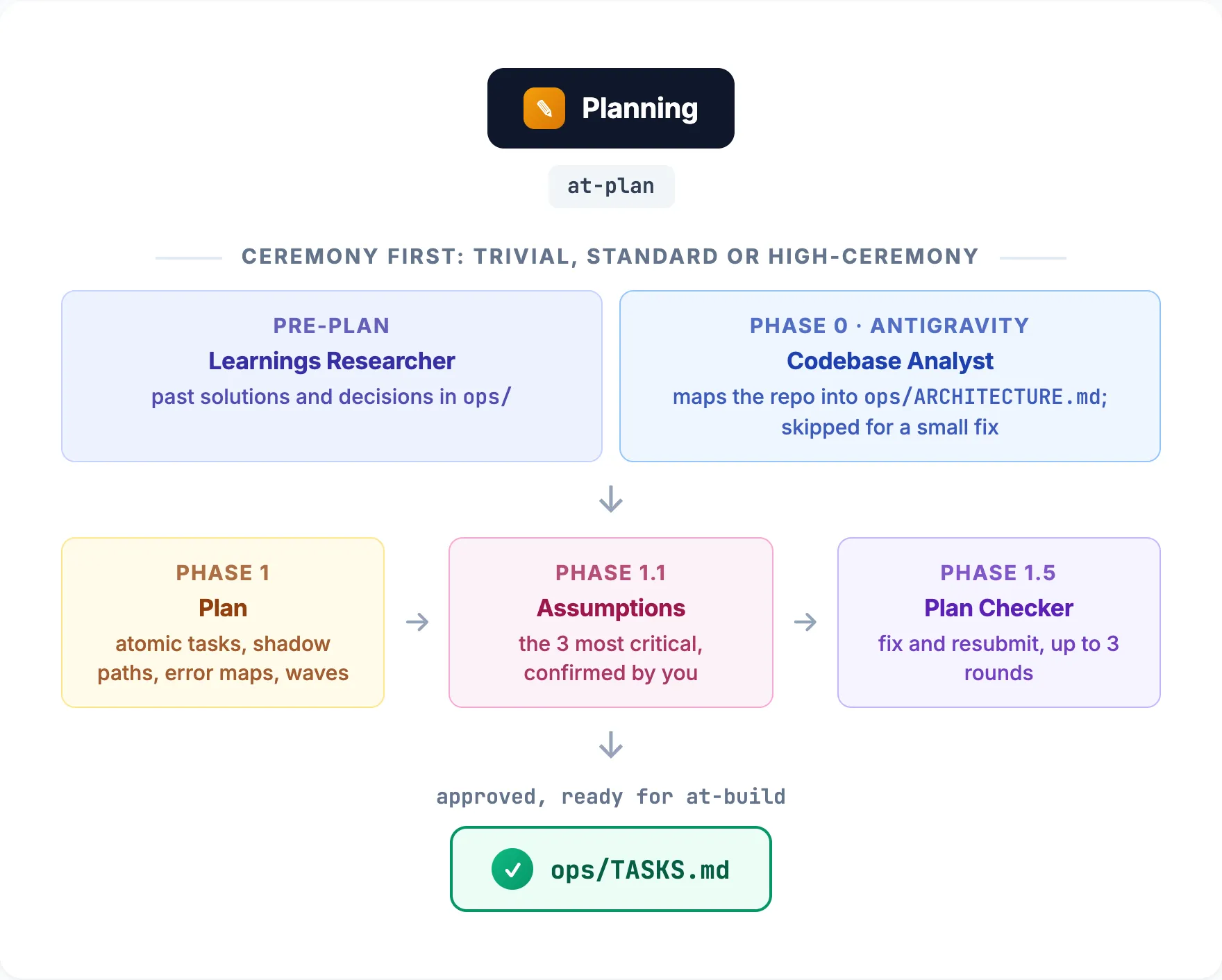
at-plan analyzes the full codebase with Antigravity's 1M-token context, searches institutional knowledge, decomposes the goal with shadow paths and error maps, asks you to confirm the riskiest assumptions, and then validates the plan with plan-checker. It writes ops/TASKS.md with its Ceremony: line.
Test Pipeline (at-test)
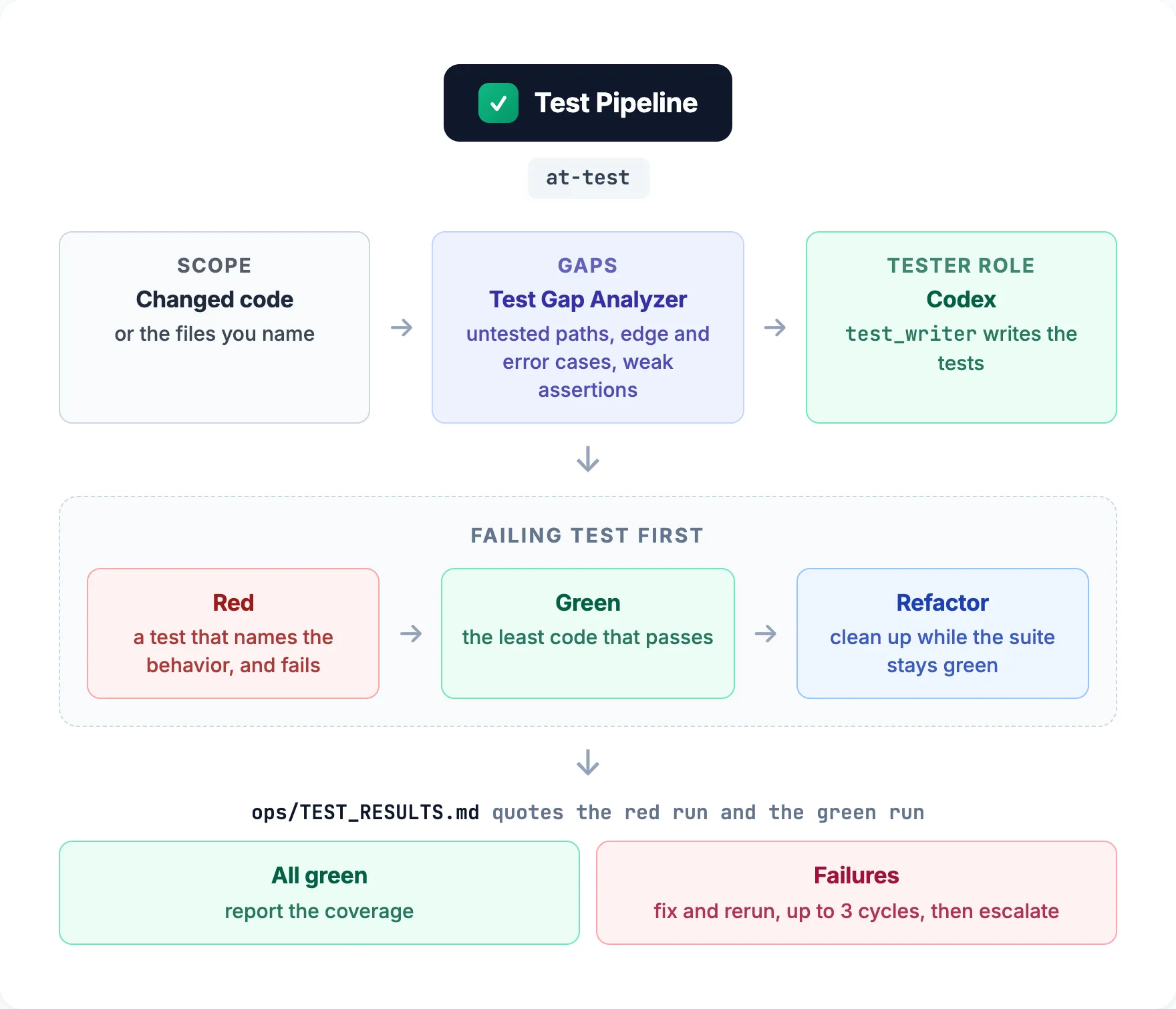
test-gap-analyzer finds the untested code paths, then the roster's tester (Codex by default) writes and runs the tests in its sandbox, starting each one with a failing test. ops/TEST_RESULTS.md quotes the red run and the green run. Failures go through up to 3 fix cycles, and what still fails after that is escalated to you.
Debugging (at-debug)
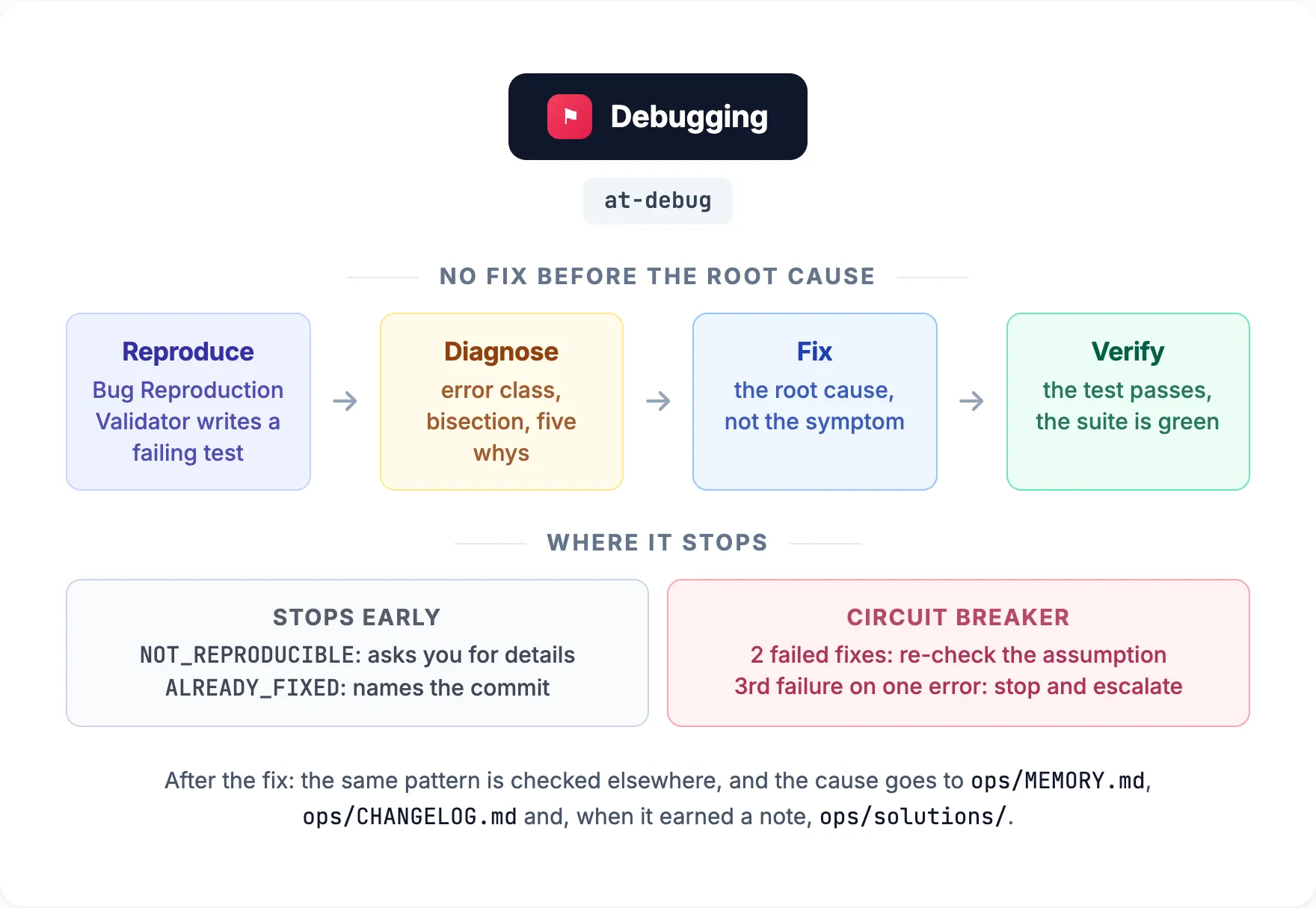
at-debug reproduces the bug first, finds the root cause with evidence, and only then fixes it. A report it can't reproduce goes back to you with a request for details, and a bug that is already fixed is reported with the fixing commit. A circuit breaker limits the attempts. After two failed fixes the agent stops and re-checks the assumption behind them; after a third failure on the same error it stops and writes an escalation report (the error signature, what was tried, a suggested next step).
Quality Gates
Five gates hold at every stage:
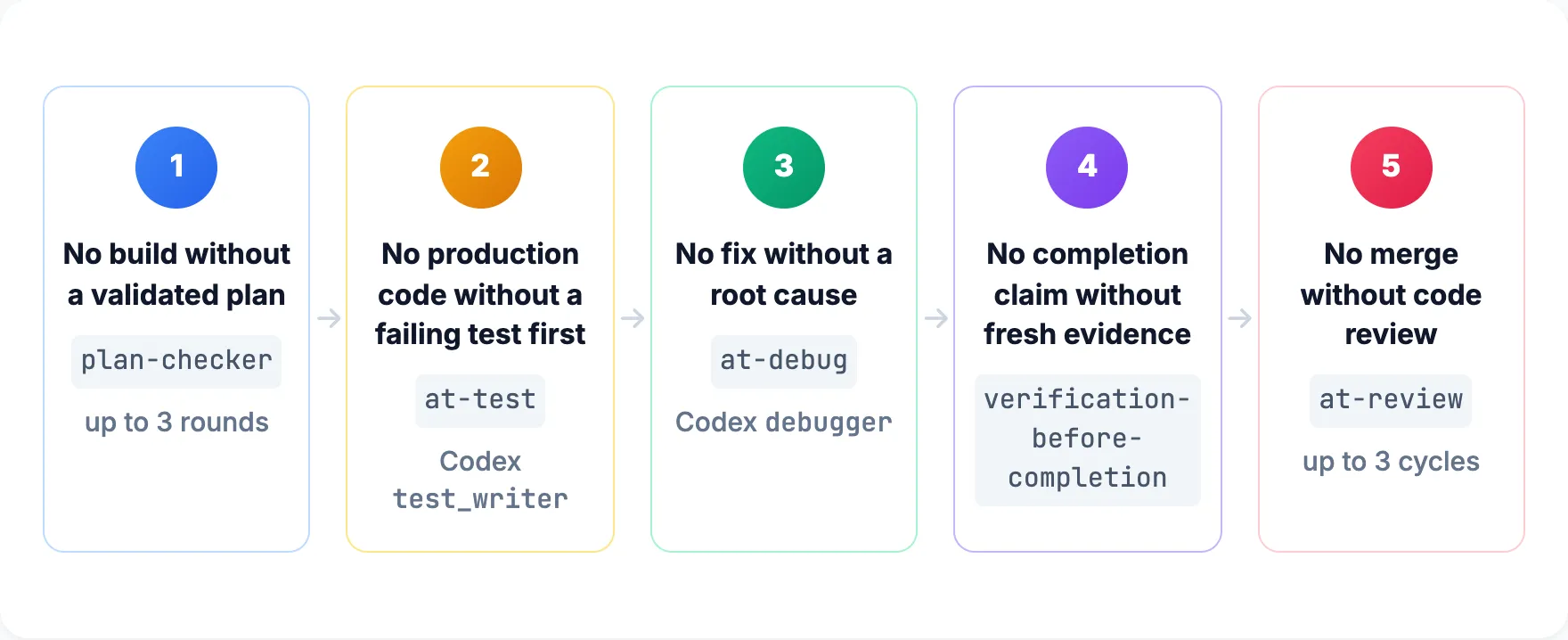
| Gate | Enforced by | Rule |
|---|---|---|
| 1, Plan validated | plan-checker persona |
No build without a validated plan (max 3 iterations) |
| 2, Failing test first | at-test workflow, Codex test_writer |
No production code without a failing test |
| 3, Root cause first | at-debug workflow, Codex debugger |
No fix without diagnosis |
| 4, Evidence first | verification-before-completion skill |
No "done" without proof |
| 5, Review first | at-review workflow, which merges findings with the review-synthesis skill |
No merge without code review (max 3 cycles) |
Lead workflows reference
The 17 lead workflows are skills under skills/at-*/ that only the lead runs. Type /at-<name> under a Claude Code lead or $agent-triforge:at-<name> inside a Codex prompt. They stay in the lead's plugin install and are never copied into .agents/skills/ or a lease worktree (KTD12). Each SKILL.md states the workflow's goal, its done condition and the direction it fails safe; the detail is in its references/ folder. In 3.x these were slash commands without the prefix (/ship, /setup); see Upgrading from 3.x.
| Lead workflow | Claude Code · Codex | Arguments | What it does |
|---|---|---|---|
at-ship |
/at-ship · $agent-triforge:at-ship |
<goal> [--convergence fast|standard|deep] [--team] |
Fully autonomous sprint: analyze, plan, build, review, test, wrap; prints a copyable completion line (a best-effort /goal line under Claude Code) at the start and creates ops/.sprint-complete last. fast = P1 only, deep = P1 + P2 + P3 below 3; --team for 5+ or interdependent tasks. |
at-coordinate |
/at-coordinate · $agent-triforge:at-coordinate |
<goal> |
The plain Phase 0 to 6 sprint cycle that scripts/coordinate.sh drives across fresh sessions; same pipeline as at-ship without convergence or team flags. |
at-plan |
/at-plan · $agent-triforge:at-plan |
[goal] |
Phases 0 → 1.5: codebase analysis, knowledge search, shadow paths, waves, the three-assumption ambiguity check, plan-checker validation. Writes ops/TASKS.md with its Ceremony: line. |
at-build |
/at-build · $agent-triforge:at-build |
[--team] [--wave N] |
Phase 2: wave orchestration over leased builder-pool tasks, cross-review by a pinned reviewer, one squash commit per task, integration-verifier per wave, the [promotion] gate. |
at-review |
/at-review · $agent-triforge:at-review |
[--full] [--security] [--perf] [--simple] [--conventions] |
Phases 3 and 4: parallel roster lanes plus the selected specialists, synthesis, P1/P2 fixes, ## Review dispositions — Cycle N in ops/TASKS.md; escalates after 3 cycles. A lane that reports less than Coverage: complete (self-reported), or omits the line, is a gap the cycle cannot converge on. |
at-test |
/at-test · $agent-triforge:at-test |
[--gaps-only] [scope] |
Phase 5: gap analysis, tests from the roster tester with the failing run first, results in ops/TEST_RESULTS.md, up to 3 fix cycles, then escalation to you. --gaps-only stops after the report. |
at-wrap |
/at-wrap · $agent-triforge:at-wrap |
(none) | Phase 6: compound knowledge, update the ops/ files, archive review files to ops/archive/<today>/, write STATE.md, print the sprint summary with its rulings, create the completion marker last. |
at-quick |
/at-quick · $agent-triforge:at-quick |
[change description] |
A change touching fewer than 3 files with no shared interface or protected path: TDD, self-review, no swarm; hands off to at-review --security / --perf when a lens needs it. |
at-debug |
/at-debug · $agent-triforge:at-debug |
[bug description or error message] |
Reproduce, root-cause with evidence, fix, find sibling instances, record in ops/MEMORY.md and ops/CHANGELOG.md; after two failed fixes it re-checks the assumption, and a third failure on the same error ends in an escalation report. |
at-setup |
/at-setup · $agent-triforge:at-setup |
[lead|opencode|kimi|cursor|devin|grok|roles] |
Guided project setup: lead chosen, core trio live, Codex trust detected, roles kept, customized or restored, each optional CLI enrolled or declined, instruction files checked and changed only on a yes, egress listed; closes with the status table and a verdict. Idempotent. |
at-deep-research |
/at-deep-research · $agent-triforge:at-deep-research |
[topic or goal] |
Five parallel research lenses plus research-synthesizer, every endpoint a recorded primary source; writes ops/RESEARCH_ANTIGRAVITY.md and hands off to at-plan. |
at-analyze |
/at-analyze · $agent-triforge:at-analyze |
[github-url or local-path] |
Read-only judgment of an external repo or resource: extractable patterns, prompt-engineering insights, verdict matrix, ranked recommendations. Nothing written. |
at-status |
/at-status · $agent-triforge:at-status |
(none) | One report from ops/, git and the review files: phase, task counts, blockers, recent activity, pending reviews, uncommitted changes, available workflows. Writes nothing. |
at-pause |
/at-pause · $agent-triforge:at-pause |
(none) | Write the STATE.md checkpoint a later session resumes from, and nothing else. |
at-resume |
/at-resume · $agent-triforge:at-resume |
(none) | Restore STATE.md, re-prove the baseline when HEAD moved, summarize, continue the recorded phase. |
at-compound |
/at-compound · $agent-triforge:at-compound |
[solution | decision] <description> |
Record a solved problem in ops/solutions/ or a decision in ops/decisions/ when it clears the counterfactual bar; otherwise one line saying why nothing was written. |
at-resolve-pr |
/at-resolve-pr · $agent-triforge:at-resolve-pr |
<PR number or URL> |
Work through GitHub PR review comments via pr-comment-resolver: implement, answer or defer each, run the tests, update ops/CHANGELOG.md. |