Unattended runs
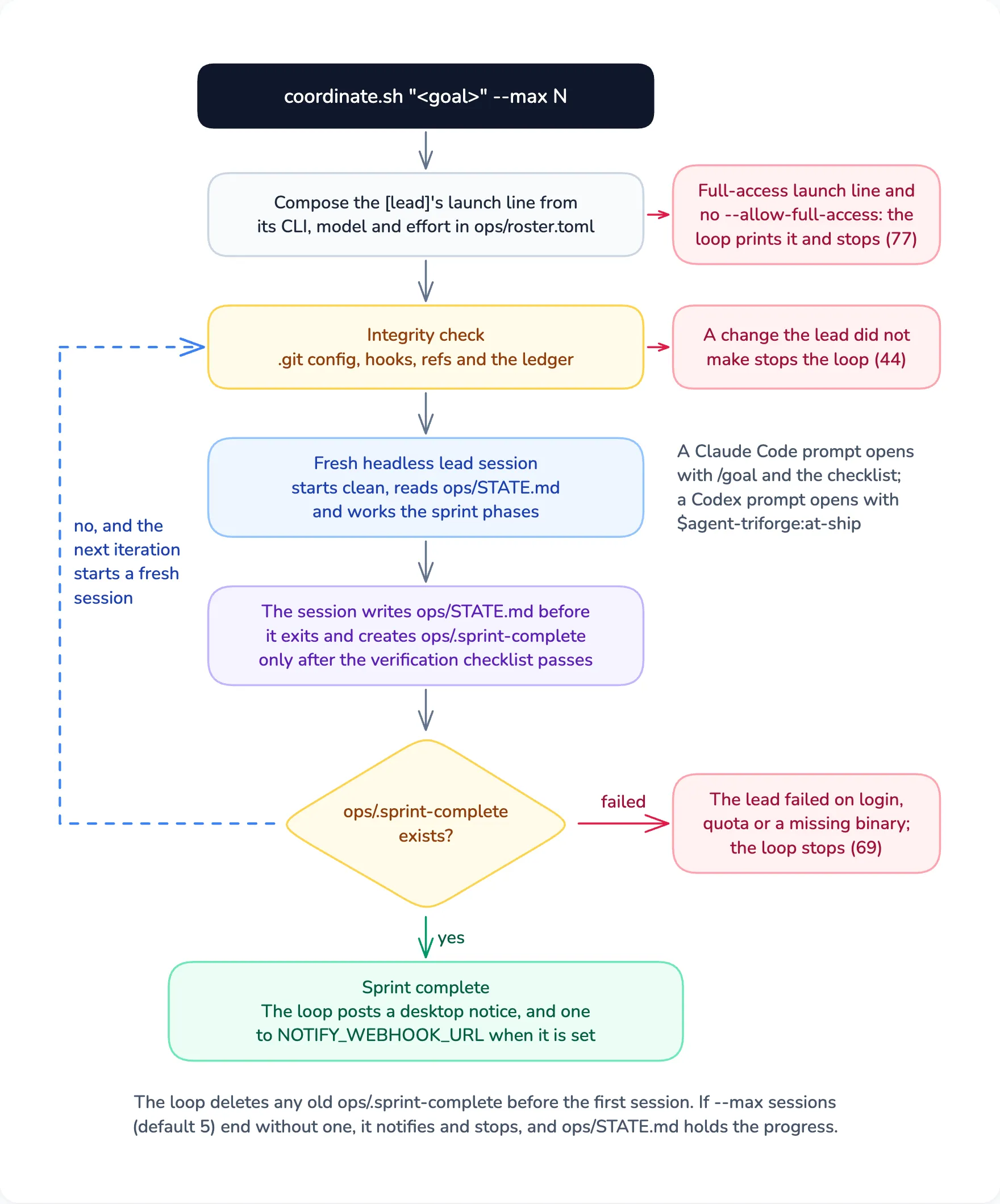
A sprint can run with nobody watching in two ways. at-ship runs every phase in one lead session. scripts/coordinate.sh drives the same sprint from a terminal through as many fresh lead sessions as it needs, so a full context window doesn't end the run. Either way the sprint is done only when ops/.sprint-complete exists. The lead creates that file as its last step, after the verification checklist passes.
In one session: at-ship
Run /at-ship <goal> under Claude Code or $agent-triforge:at-ship <goal> in a Codex prompt. --convergence sets when review stops: fast once no P1 finding is left, standard (the default) once no P1 or P2 is left, and deep once, on top of that, fewer than 3 P3 findings remain. At every level, a lane that reports less than complete coverage or omits its Coverage line blocks convergence, and a cycle that applied a P1 or P2 fix reviews the changed files again. --team builds in agent-team mode, for 5 or more tasks or interdependent ones.
At the start at-ship prints a copyable completion line. Under Claude Code it is a /goal line you can type. /goal is an assist (CC-03 went 0 of 3 on 2.1.318) and ops/.sprint-complete plus coordinate.sh decide completion. A Codex lead has no /goal, so it completes on the marker alone. The checklist:
- Every phase is done, or skipped with a stated reason.
- The
verification-before-completionchecklist passes with evidence. ops/STATE.mdis written for the next session.- Temporary review files are archived to
ops/archive/. ops/.sprint-completeis created last, only after 1 to 4 hold.
If any item fails, the lead creates no marker and records the blocker in ops/TASKS.md and ops/STATE.md.
Across sessions: scripts/coordinate.sh
-
Open a terminal in the project's top directory. The script ships in the plugin install, and session start records that path as the last line of
.agents/triforge-plugin-root.local:TRIFORGE="$(tail -n 1 .agents/triforge-plugin-root.local)" -
Preview the run.
--dry-runprints the lead's launch line and the prompt for the first session, and runs nothing; add--lead codexor--lead claudeto compose it for the other lead:bash "$TRIFORGE/scripts/coordinate.sh" "Build the authentication module" --dry-run -
Start it.
--max Ncaps the sessions (default 5), and--convergenceand--teampass through to the sprint:# Full autonomous sprint with context recovery bash "$TRIFORGE/scripts/coordinate.sh" "Build the authentication module" --max 5 --convergence deep --team # With completion notification via webhook NOTIFY_WEBHOOK_URL="https://hooks.slack.com/..." bash "$TRIFORGE/scripts/coordinate.sh" "Build auth" --max 5 # Under a Codex lead: preview the launch line and prompt, then run with full access acknowledged bash "$TRIFORGE/scripts/coordinate.sh" "Build auth" --dry-run --lead codex bash "$TRIFORGE/scripts/coordinate.sh" "Build auth" --max 5 --allow-full-access
Run it from a terminal or from the lead's own shell. Under nohup, cron or CI there is no terminal, so the script stops with exit 45 before any session starts.
What the loop does
- It resolves the lead from
[lead]inops/roster.toml, checks that the lead's CLI is onPATHand thatTMPDIRis private, and deletes any staleops/.sprint-complete. - Before every session it runs the lead's git integrity check. When
.git/config, the hooks, the refs, a worktree pointer or the lease ledger changed in a way the lead did not make, it restores what it can, escalates the open leases and stops with exit 44 before the session starts. Check the change, accept it withlease_rebaselineif you made it, then rerun. - Each session is a fresh lead process started with the registry's launch line plus the
[lead]model and effort. Under Claude Code the prompt opens with the/goalchecklist;/goalis an assist (CC-03 went 0 of 3 on 2.1.318) andops/.sprint-completepluscoordinate.shdecide completion. Under Codex it opens with$agent-triforge:at-shipand carries the checklist as text. The session readsops/STATE.mdfirst. Whenops/leases.tomlstill holds open leases, the prompt tells the session to rebuild the wave from the ledger instead of starting it again, and to bring up any failed or escalated lease for a decision. - After each session the loop looks for
ops/.sprint-complete. If it exists, the sprint is complete. If the session failed in a way every new session would repeat (not logged in, quota spent, binary missing), the loop stops with exit 69 and prints the fix. Otherwise it starts the next session. - When the sprint completes, stops on a failure or runs out of sessions, the loop posts a message to
NOTIFY_WEBHOOK_URLwhen you set one, and shows a desktop notification (osascripton macOS,notify-sendon Linux).
Under a Codex lead
A Codex lead's launch line runs with full access: -s danger-full-access and no approval prompts. coordinate.sh runs it only when you pass --allow-full-access. Without the flag it prints the line and the statements of what confines it, then exits 77 having run nothing. at-setup prints the same line for an interactive session, and typing it is your step. The "Confinement, stated as it is" section of AGENTS.md says what confines a full-access lead and what doesn't.
When a run stops
| Exit | Meaning |
|---|---|
| 0 | The sprint is complete, or the dry run printed |
| 1 | Usage error, a lead that can't be resolved, its CLI not on PATH, the helper library missing, or a TMPDIR other users could change |
| 44 | The integrity check found a change before a session (restored and escalated; inspect it, then lease_rebaseline) or could not run |
| 45 | This shell may not run the lead's loop: another CLI's shell, or no terminal (nohup, cron, CI) |
| 69 | The lead failed in a way that would repeat (not logged in, quota spent, binary missing); the fix is printed |
| 75 | The sessions ran out and none created ops/.sprint-complete; the closing lines say so. Run the script again to continue |
| 77 | The launch line needs full access and --allow-full-access was not given; nothing ran |
When the sessions run out (exit 75), ops/STATE.md and ops/TASKS.md hold the progress. Run the script again to continue, or review by hand.
Stopping a run early
Press Ctrl-C in the terminal running the script. That ends the loop and the lead session it is waiting on. Builders that session started keep running, because each runs detached in its own process group, and their leases stay open in ops/leases.toml. Run the script again with the same goal to continue. The next session finds the open leases, collects the builders that finished and carries on with the wave.
To stop the builders too, load the helpers in the same terminal (in the project's top directory, with TRIFORGE set as in step 1), list the leases and stop each one still running. lease_stop leaves the lease in the ledger, for the next session to reclaim or requeue:
source "$TRIFORGE/scripts/invoke-external.sh"
lease_status
lease_stop <task_id>